
Morocco: Act I
We set out with the highest of hopes and rock solid plan to figure things out when we got there. Our rooms were booked, and our agenda set, but the details on how we’d get from one place to the next were less clear. There are taxis and grand taxis and drivers and buses. There are camels. We would make it.
The flight takes seven hours. If we sleep, we land in the Moroccan morning refreshed and ready to take in Marrakech. We do not sleep. We watch some Lost, do some crosswords, and generally squander our time to rest. I began The Sheltering Sky and girded myself against visions of post-war Morocco and the dangers of entanglements foreign and domestic. Our layover in Casablanca was one blink of an eye, and then another for the flight to Marrakech. We found our driver and headed out of the city to Kasbah Dar Ilham. On the way there, I believe I’m in Africa when I see a few cows riding atop the roof of a truck, penned in by the shortest of walls. We arrive at the Kasbah and it truly is an oasis from our long travels. Set in a palm grove, it is the standard for the places we’ll stay. We’re served steaming mint tea, a mixed BBQ, and vegetable tagine. While the food in Morocco is less diverse than in India, it’s well spiced and suits the environment in a way that nothing else could.


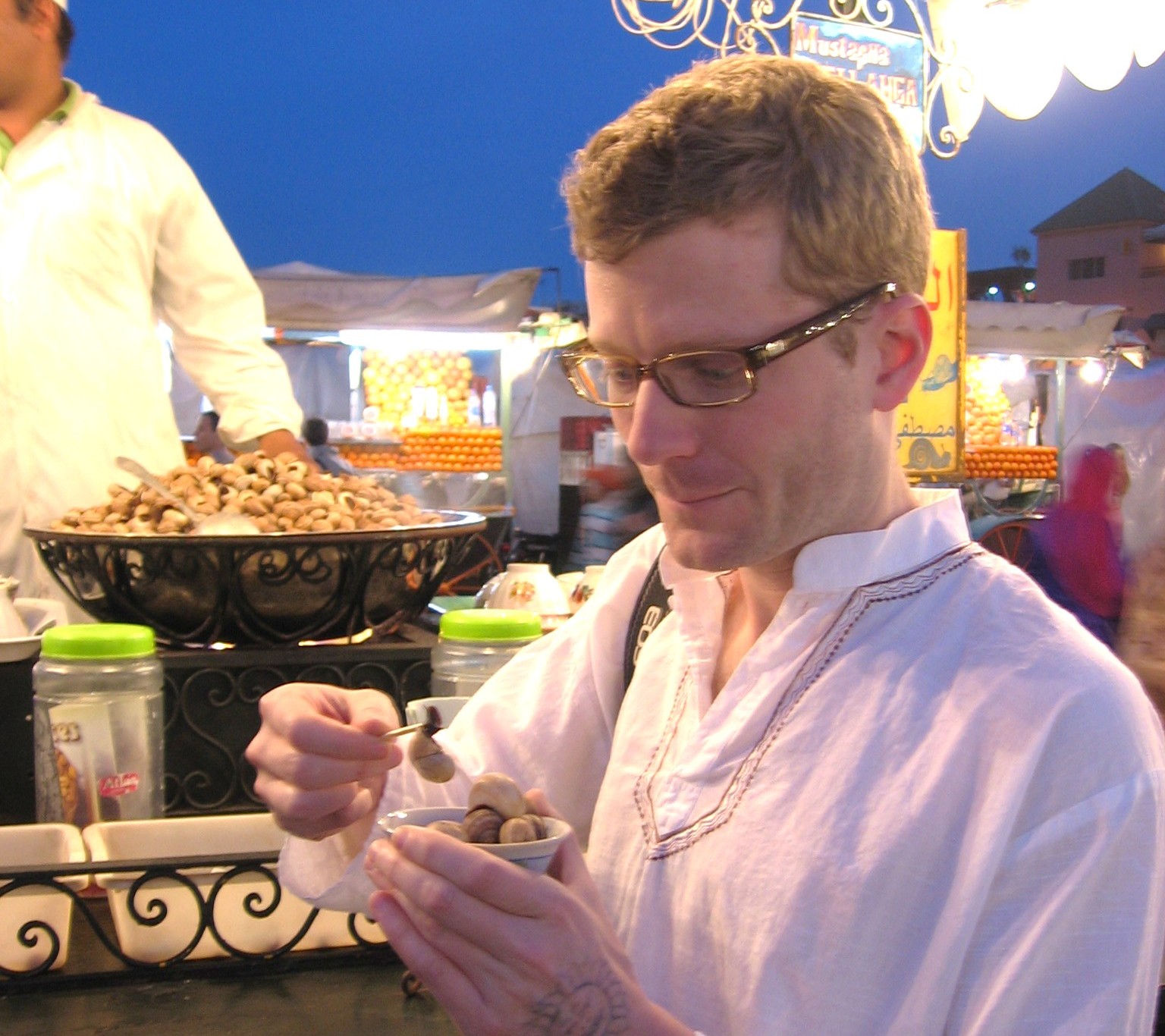
We grab a few hours of sleep before heading back to the city to see the Marrakech nightlife. The central square of the Medina is bustling with tourists and street vendors. We grab a bowl of snails from a stand for 5 dirhams (about $0.65). This is the cheapest food we ate and some of the tastiest. These are not French snails drowned in garlic butter, but Moroccan, boiled in spiced water, still clinging to their shells. Just off the Medina winds street after street of souks: small shops selling touristy goods to the streaming parade of visitors. I think I’ve finally overdosed on souvenirs and enjoy just watching all the madness. I’m enthralled watching a man lathe some shish kebab skewer handles with his feet. He uses his hands to spin the dowel along its axle using a little bow. It’s as if he’s trying to start a fire on a desert island. With his foot he pushes the chisel into the dowel, notching out intricate details into the wood.

We head back to the kasbah to catch up on the lost sleep and spend a night in the quiet of Africa.
Our first full day in Marrakech, we devour as many tourist sites as we can. The Mederrsa Ben Youssef is an old school, built in the 1500s for theological studies. It’s a maze of small rooms, spiraling off into even smaller rooms. A few are done up historically to show how scholars sat and read from religious texts. I imagine they did a fair amount of duplicating as well. Next it’s on the Museum of Marrakech, where we spend about fifteen minutes. It’s a beautiful building, with a main room dominated by a mammoth lantern, but otherwise there’s not much to see. We cross the street to the Almoravid Koubba. It dates back to the 1100s and has some really creepy rooms under the ablution chamber. Wikipedia tells me that the inscription over the entrance reads:


“I was created for science and prayer, by the prince of the believers, descendant of the prophet, Abdallah, most glorious of all Caliphs. Pray for him when you enter the door, so that you may fulfill your highest hopes.”
We have another lovely dinner of meat for Jenny and vegetable tagine for me. Everywhere we go, the city is infused with dark warmth that speaks of hospitality given to countless travels over centuries. Marrakech is for tourists, but I feel like it always has been. One of the last stops between the ocean ports and the long long trade routes deep into Africa. We did not come for Marrakech, but we enjoyed our time there. We head back to the kasbah excited to leave in the morning for the desert.
To get into the Saharan Desert, we have to cross the Atlas Mountains. They get as high as 14,000 feet, but per my habit we take the low road and cross at a mere 7,400. The road ahead of us is breathtaking, and unlike any other climate I’ve seen. I really feel like I’ve gone somewhere. We climb through the morning mist. The road snakes through the peaks, and brings us by small nomad encampments. Many have setup makeshift roadside stands where they sell local minerals and geodes, and even fossils pulled from the Atlases. I contemplate buying some trilobites, but get a little creeped out when I see all the legs. It is not an easy drive, and we leave the windows open to get some air as the hair pin turns taken at breakneck speeds threaten our constitution. We pass a herd of black goats mingled within a heard of white sheep. Their mountain-side checkerboard of fluffiness is almost overwhelming.

By the time we’re through the mountains, we’re just a short drive from our stop at the UNESCO World Heritage Site Ait Benhaddou. We park the car on the side of the road and hike down some switchbacks trying to end up at the foot of the compound. But lying across our path is a river about 30 feet across and a couple feed deep. It’s free to roll up your pants and walk across, but the donkey rides cost a few dirhams each. For some reason Jenny is not allowed to ride alone, but otherwise we make it across without incident. Ait Benhaddou is a collection of individual Kasbahs that make up a decent sized fort. It’s similar in scope to one of the Rajasthani forts I saw in India, but instead of being a singular structure devoted to protecting a seat of power, it’s a community of families tied together for mutual protection. Like most historical buildings in Morocco it’s built from a mixture of dirt and clay and straw and rocks and wood. Every time it rains, the exterior changes. It must be under constant repair, but retains an authentic and timeless look. Movies of every era have been shot here, from Lawrence of Arabia to the 1990 adaptation of The Sheltering Sky. Even Time Bandits shot here. There’s such a beauty and authenticity to this place, and it’s set in such a remote location, that it makes some of the other sites I’ve visited over the last year seem like tourist facades.

 For another few hours we drive down long roads stretching out across rocky African plains. We stop here and there for photos, but make haste to get to Kasbah Itran before nightfall. None of these places have clear addresses, and some have the same names as other establishments, but we find it just as the sun is setting the countryside into darkness. This place is weird. While it’s been renovated for modern use like most of the Kasbah hotels, it retains much of its archaic charm. The whole building is heated by a central fireplace, and once the fire begins to die a chill sweeps through. Electricity is strung haphazardly throughout with outlets hiding behind tapestries, and random wires dangling out of alcoves. Our dinner of meat and vegetable tagine is followed by a lively drum session from the Berber staff. It’s casual and festive and gets everyone in a good mood. Afterward, a young man in a robe and turban gathers the guests around a small table where he demonstrates a series of riddles and magic tricks using a few props like candles, coins, and glasses. It’s entertaining and we sit transfixed on his movements pretty late into the night. We stumble up to our room and pile the sheets and blankets from two beds on top of ourselves to warm us through the night.
We set out early for our last day of driving before we reach the desert. The landscape continues to amaze. The rocky vistas are flooded with bright green eruptions of grass and trees. It must be our proximity to the coast, but even as we approach the sands there is a well kept balance between drought and deluge. Films lead me to believe the oasis were rare jewels dotting the country, but maybe they only seem that way when one is on camel or on foot. We stop at the Todra Gorge, a narrow rift between rock cliffs where a thin stream pushes water fresh from a spring across the cracked earth. It’s a tourist haven with restaurants dotting the path, and rock climbing operators helping the ambitious scale the sheer walls. We wanted down the stream, snapping photos of the various amazements. Before long we’re back in the car and back on our way.

 Amidst a barren stretch of land, white with salt, we pull to the side of the road at the site of a nomad well. There’s a makeshift winch built to add leverage for the water’s hoisting. Jenny poses for pictures as a nomad walks towards us from a ways off. I flash back to the amazing scene in Lawrence of Arabia where Omar Sharif snipes Peter O’Toole’s guide for drinking from his well. I try to explain to her the power of the line, “My name is for my friends, and my friends are not murderers!”, but I can’t pull it off. We hustle back into the car before the nomad reaches us and pull away as he holds up some small crafts he wanted to sell us.
Our last stop before the desert is a factory where the rocks and fossils mined from the mountainside are cut and polished into the tourist treasures sold at every turn. It’s an impressive operation with saws and grinders and polishers. I stand too close to the massive saw slicing a giant block into thin slabs and get covered in a layer of paste made from the pulverized stone and the water used to cool the saw. They make everything from tiny key chains, dotted with fossilized organisms to polished countertops teeming with trilobites and spiraled gastropods.
Back in the car, we race through currents of sand blowing across the countryside. It flows in ripples and waves, blanketing everything in a fine layer of grit. With our windows open, that includes us; especially our ears. It’s a few hours before sunset and a sand storm is coming. Roadside signs point the way to Merzouga where we will transfer at an outpost from our piloted car to our guided camels. But rather than follow the signs, at a seemingly random point in the road, we veer off into the rocky plains. Here, the desert is littered with shrubs. We’re off-road in the Sahara in a growing sandstorm that’s blotting out everything beyond a few dozen feet. We’re on our way to the desert.

More to come…
One Comment
Comments are closed.
 Zachster
This introduces a paeslingly rational point of view.