
My goal was to stay off the beaten path and route my way through Greece onto some islands. I thought busses and trains would take me most of the way, and taxis could be used sparingly. But the bus system refuses to cooperate. From any town, one can get to Thessaloniki or Athens, but there are no routes connecting village to village. I did find busses to get me to Kastoria, but it was easier to just pay the taxi who drove me across the border a few extra euros to take me on to Kastoria. It was a nice ride through lush country. The border between Macedonia and Greece is an 800m no-man’s-land between two fences. It’s a barren desert cut through the rolling green hills. The was a subtle difference after crossing. I noticed a lot of cultivated trees fenced in to front yards, and small houses spaced more closely together. But largely it is the same land.
It’s useful to have a GPS. Without it, we’d be stopping and asking for directions at every turn. It’s kind of like cabbing in Brooklyn.
When we arrive in Kastoria, the driver leaves me outside what I think is the hotel. But there’s been a problem. The booking site I used wasn’t finding the address properly so it dropped a pin in the center of Kastoria. I realized this a few minutes after the taxi left. After a brief period of accusing the hotel I’d been left at that they were indeed my hotel, I realized what happened. The hotel I’d booked was a couple miles north of town in an area called Chloe. It looked far on the map and I felt I’d be too distant from the city center to easily tour around. On the phone with my hotel, I tried to get out of the room but couldn’t explain my situation. I acted badly, pouting and complaining. I do this when I don’t get my way. It’s unseemly. It was no one’s fault, but I made myself the villain. I grumbled through my cab ride north and my check-in, bemoaning my woe; ignoring the fact that the hotel was beautiful and two stars nicer than any other so far on this trip.
After cleaning up a little, I made the long walk back to town. The road curled around the lake that drew me to Kastoria. I’d heard there was swimming and water skiing, but the lake was a deep green with swirling currents of algae. It didn’t smell right, either. But the walk was nice, and by the time I reached town I was eager to find a meal. I found a tavern overlooking the square in the old part of the city. They were out of fresh fish, but I had a tasty smoked trout salad and a glass of wine. I tracked down a geocache just off the city center. It was a film canister hidden inside a lamppost by a bench. Maori and I are always looking inside the bases of lampposts for them, but never finding any. Maybe it’s only done in Greece. It was getting dark, so I took a taxi back to the hotel and let the food and some sleep finish the job of curing my gloom.
The included breakfast was a broad array of greek treats, including coffee that was somehow made in a pot under hot sand. Afterwards, Margarita, the owner offered to drive me into town so I could rent a bicycle. She took a long and scenic route and gave me a great tour of the town. She and her husband also work as civil engineers and have been restoring buildings in the historic older city. The numerous Byzantine churches dotting the hillside are closed for renovation but she offers to have the museum officials open some for me. I politely (I think) decline and try to shrink deeper into my shame at being so snotty about the hotel’s location. I’ve set myself up as a victim and am being flooded with hospitality. Were I not feeling so uncomfortable about it, I’d consider it a good strategy for getting excellent treatment in the future.
Kastoria is an interesting shape. The lake makes something of a cartoon mouth, agape surrounding the uvula of land on which much of the city rests. At the Southern edge of the peninsula I rent a squeaky mountain bike and set off for some sort of archeological village a few miles away. None of the translations make much sense to me, but it’s a nice distance away, and promises to be mostly outside. A fork in the road offers me the choice of the dig site, or the eco-museum. I hit the dig site first.
It’s completely deserted. Abandoned. Rectangular pits stand as wounds against the grassy field: their walls eroding and their floors sprouting tall grass. A few of the pits descend to water level and are filled with algae. I walk nonchalantly closer when all the sudden there’s a distributed explosion of movement across the surface of the pond. I take another step and round of movement; slightly smaller. Every step I take sends a flock of frogs hopping to safety. I actually squeal with laughter.
Another pit is dotted with an array of thin tree stumps. They’re jagged and petrified, poking out of the ground. Around them, the land has dried with alkaline stains. I can’t imagine what it could be except the remains of some dense tree grove. But when I bike over to the eco-museum I realize that these posts are the foundations of a hut. The village that had been here some 2500 years ago was built on the shores of a river, the huts lifted on stilts as protection against animals. The recreation is charming, complete with raised platforms and walkways. Each hut is decorated with an assortment of ancient tools and weapons.
I bike back to town and tour the newly opened Dragon Caves Margarita told me about. It’s hot hot hot outside and at the doorway to the caves I’m hit with a blast of sweetly cold air. The caves are lower and more sprawling than the ones I saw in Matka, and the path winding through leads us over a number of reflecting pools. The caves were discovered some fifty years ago when a road was being built nearby. Some local boys stumbled into it. I wonder how long it took them to tell anyone. If I thought I could hide it for myself, I might never have told. The guide told me one of the boys is still in the town. He’s seventy-five.
I spend the rest of the day browsing around town and eating as often as possible. The anchovies are so good and the wine so cheap that I’m constantly getting drunk and eating more. Ohrid had a festive atmosphere that I don’t feel in Kastoria. I don’t know if the mood has been changed by the condition of the lake, or if it’s just less of a vacation destination. While Kastoria is bigger than Ohrid in population, I think Ohrid ranks higher as a destination for Macedonians than Kastoria does for Greeks. But it’s a charming place, and the lack of tourists makes me feel like a local after even the short time I’ve spent here.
The next day I taxi to the bus station and purchase my ticket to Thessaloniki. It’s a two or three hour ride straight East across Greece. The Mercedes bus is ridiculously comfortable, and I drink in the country side as I make my way towards the sea.
My plan was to head to Thessaloniki after my time in Skopje and then head down the Greek coast to Athens. That’s the route Macedonians recommended. Whatever issues the Greeks and Macedonians share with each other, Thessaloniki (and specifically Halkidiki) is seen as a great escape. But on urging from my cousin Annabel, I decided to venture West to Lake Ohrid. I don’t consider myself an easily influenced person, but this whole trip has been motivated by whims. It’s not hard to change my mind when it was never set firmly in the first place.
The bus took about three hours and pulled into town in time for a late lunch. The short hike from the bus stop to the hotel showed me most of the village center. I passed the open market, packed with vegetables, and the short strip of shops catering to the beach crowd.

Hotel Alexandrija sat just meters from the lake shore, and my room was full of windows looking out over the water. Small boats dotted the horizon as children jumped from the seawall into the shallow water. After a quick lunch of salad and trout (caught in the lake maybe?) I made a quick arc around my corner of the lake, checking out the beaches and planning my attack. It wasn’t quite what I expected. Instead of any sand, the beaches scattered along the shore were full of gravel, or merely slabs of concrete offering some lounge chairs or a flat surface for a towel. And where there weren’t these ‘beaches’, children played on the pedestrian walkway and jumped in and out of the water straight from the walls, or little stone stairways leading down into the clear water. The most inviting spot to me was a short pier that lead to a concrete platform stretching out into the water. It had room for a dozen or so sun bathers and a few kids playing just off its shores. Either from ancient settling, or recent quakes, the platform had cracked and canted in a few places, creating private regions to camp and take in the sun.

I’d been worried about traveling alone. My time in India felt artificial and stifled. But the further I get from that trip, the more I think it was my mode of travel more than my lack of companions that made me uneasy. Too much had been planned out, leaving me too much time to dwell on my solitude. Finding my way on my own, and planning my itinerary as I go takes up enough time and effort to make this whole trip an adventure.
And without a firm timetable set by a travel agent, I was free to wander into the night, taking in sights of lake. I was trying out some long exposures, trying to get some decent photos of lights across the lake when I noticed a girl caught in the frame. I thought she might be interested in seeing the picture. When this type of impulse strikes me, it’s hard for me to resist. I come up with all sorts of reasons not to… dwelling on how awkward it will be, and how unnecessary. But it’s just my fear keeping me in seclusion. I learned long ago that the shame of letting my fear win out is worse than any awkward memories I’m left with. So I walked over and sat down. Elena is a master’s student in computer science at a university in Skopje. We had a nice amount of things to talk about and ended up at a bar, joined by her friend… a motion graphics animator (I’m so bad with names)… drinking and talking for a few hours. And so my first night in Ohrid, and my first night on my own, ended full of company and liquor.

It was hard to sleep past eight as light crowded my room, so I pulled on some beach clothes and found a nearby omelet. My only goals for the day were to get some swimming in and maybe take a boat ride. I’m not swearing off sand beaches anytime soon, but there was a great security laying out on the hot concrete of the island off the pier. With music and audio books to occupy my mind, it was a couple hours before I got into the water and splashed around. The island was perfectly situated with some nearby shallow areas, and some deeper where the bottom could be neither touched nor seen.
I tricked a pair of sisters into making conversation by asking them to take a picture or two of me. Tanja and Emilija grew up in Kocani on the Eastern end of Macedonia. Tanja was home for the summer from Milan where she works at something (“a nurse, but not a nurse”, she said), and they visited Ohrid to get some sun and water.

After wrapping up on the island, we agreed to meet up later and walk around. We climbed steep steps up into the hills to check out a church, and stopped in to see a quick demonstration of how local paper is handmade. It was kind of like magic when the papier (is that right?) dipped his screen into the milky liquid and sifted out a shallow film of wood pulp. Flipping the screen over onto a cotton rag, the pulp immediately became a thin sheaf of paper. Magic.
The highlight (for me) was taking a small boat ride, just before sunset, out on the lake. Most of the other boats were gone, but we hailed one as it unloaded a group of passengers. I thought there might have been a dispute (in Macedonian) between the girls and the captain over the lateness of the ride, but they settled on a price and we all got in. As we’d waited to board, an older man came up in a small panic. He was holding a large remote control (the kind used for a car or plane) and was pointing out at the waves as he spoke to the captain. Out far from shore, a tiny sailboat bobbed in and out of view. Not only would we see the sunset, but this would be a rescue mission!
I noticed from our time in the water that Tanja was no fan of the waves. She went in up to her waist, but no deeper. I should have realized she wasn’t a fan of boats either. Maybe it would have been okay if we’d left earlier when the water was calm. But as the moon rose in the sky, so too did the waves on the water. We were tossed about like the lost model ship we were sent to save. We never got more than a splash or two, but as we crashed into the waves, the boat leapt up and forced us to hold with both hands onto the metal frame holding up the tarped roof. The model ship never seemed to get close, no matter how far we pushed from shore. When we were finally upon it, I realized it was much bigger than I assumed, and had only looked so small because it was so far away.

Once we’d hoisted it into the boat, and glanced at the setting sun, we all had plenty of time to dwell on how unhappy Tanja looked. My reaction to fear is to burst with laughter. I suspect that made things worse. We asked to be taken back to shore several times, but the captain felt a duty to give us our money’s worth. He did head back, but took the long way and dropped us a kilometer down the coast from where we started. But it was a nice walk back and we were happy to be on dry land.

We spent the rest of the night drinking (maybe just me) and eating and walking around town. In the central square, some sort of beauty pageant was being held and we stopped to watch for a moment. It’s a shame we were all so tired from our travels that we couldn’t stay awake late enough to take in the Ohrid nightlife. We went by a jazz club that was supposed to be hopping, but at 11pm, it was still empty. Elena had told me that the crowds would not come until 1 or 2am.

But my time in Ohrid was the perfect end to my stay in Macedonia. I came to work and did my best. I enjoyed the people and the food and my adventures. The next day I left by bus for Bitola where I caught a cab to Florina, Greece and on to Kastoria.

This was a shorter build project than the one in India, and Saturday was our last day. We finished strong, moving mountains of dirt to lay septic pipes, and glueing up meters of mesh to stand against the next quake. There was a real sense of accomplishment, inspired by the job foreman who seemed genuinely impressed. It was a contrast to the professionals in Delhi who seemed unsatisfied by even our strongest efforts at the most manual tasks. I’m not sure how to attribute this, but it gives me hope for future trips being as fulfilling.
There was a concert in Veles that night, promoted all over town with flashy posters highlighting a Brittney look-alike, framed in Cyrillic headlines. I thought it would be a nice adventure to usher us out of town, but the team leadership thought it would be too late and too risky. Instead we planned to hit the city center and get a little drinking in. But after the walk back to our hotel to change, I pooped out and left the younger kids to their own adventures. It’s been a struggle finding my place when there’s such a big age gap between me and everyone else on the project. I don’t want to be ‘that guy’ hanging around the teens, but I also don’t want to hole up in the hotel alone. Often my exhaustion after the days work makes the decision for me, but this night especially I slept restlessly until they returned well after midnight. And when one of the boys errantly walked into my room to crash, I knew some good drinking had been done and was glad they made it back safe.
The next morning we were up pretty early for our ride back to Skopje. It would be a day of sightseeing to close out the trip. But the murky silence around the breakfast table spoke of the price being paid for last nights indulgences. With bags packed, and eyes droopy, we loaded onto the bus and set out for our last day.
A few nights earlier I’d set a precedent for asking the bus to pull over after a dinner with a particularly large amount of Rakia and water. In all honesty I hadn’t wanted to use the bathroom at the build family’s apartment. Maybe that makes me a bad guest, but I didn’t want to open any doors on things I might not want to see. So I made a small joke apologizing to the girls on the bus who couldn’t really participate in our pit stop, and then invited the boys to join me. I was saved some embarrassment when three or four of the guys appreciatively followed me off the bus. So when one of the young adventurers lurched up the aisle and whispered to the team leader and driver, and we slowed to a stop, it was pretty clear what was going on… until… in fits and starts he barfed all over a team member sitting to his right. All over. It was really awful. I looked only through gaps between my fingers, but still saw more than I needed to. It was a perfect storm of too much drink, too much breakfast, and too bumpy a bus ride.
We stopped for a bit at our Skopje hotel (where I’d stayed earlier in my trip) so everyone could clean up and get some air. All in all, it was handled as well as could be expected, with sincere apologies, ample cleaning supplies, and tips for the driver.
Our day’s excursion took us to Lake Matka, an artificial finger of a lake, created by damming a river. There was a little church, and a pretty righteous bat cave. We spent a few minutes exploring its crisp and cold interiors after traversing the lake on a small boat very much like the ones on Disneyland’s Jungle Cruise. It was only after our light lunch that we realized the real fun was to be had playing upstream in the river just before the dam. The current was fast, but support structures had been built to make sure anyone swept away had something to grab before being washed too far down river. While we waited for the bus to negotiate some tight turns out of its parking space, a few of us slid down the embankment, crossed a shallow stream, and stood in the cold cold shores. It felt like it was about fifty degrees; an absolute heaven compared to the ninety degree air.
We made it back to Skopje without further eruptions, and gathered near the hotel for our farewell dinner. Memories were shared, wine was drunk, and fun was had by all. We were a few men shy as our team leader and local coordinator had to bail out on this last day as they’d been invited to meet with the Macedonian president. And one of the teens had left early. So it was a smaller group than we were used to. I was surprised by how much that changed the dynamic. But it’s not often that things all end at once. This more gradual departure seems more common.
So today I found myself back on my own, on a bus headed West to Lake Ohrid on Macedonia’s border with Albania. I was well directed and had no trouble finding my way, but I was still filled with excited anticipation. Most of the solo travel I’ve done has been under careful watch of guides and travel agents. The rest of this trip will be something new.
Each apartment building has three stories. The top two have balconies and a long floor to ceiling window down one long side. They’re framed by the cement floor and pillars holding up the ceiling. For reasons that weren’t explained to me, cement risers must be poured at the foot of these openings. It seems like the sort of thing a wrought iron railing might be laid onto. To pour the risers, we build a box out of scrap wood around a row of rebar lattice. It’s just a form to hold the cement in place while it sets, so it doesn’t have to be pretty and it doesn’t have to last forever. But it has to stay put while we knock the cement around and make sure it’s filled the form properly.
Can I draw attention for a moment to how this is a metaphor for all this habituating for humanity I’m doing? These buildings will not stand for centuries. The cinder blocks are a loose foam of concrete; light weight and stackable. Those are cemented together and coated in mesh and glue to bind the walls tight. I think it’s designed to stand up under Macedonia’s frequent earthquakes. Regardless, this development lacks the organic charm of the build family’s current neighborhood. We went over for dinner last night and had to navigate a maze of hillside streets inaccessible by van. Locals strolled through the square and kids played games in the street. The scents and sounds of supper called us in all directions. We piled into their small living room and crowded around a long table that must have been built for the night. Dishes were passed and bottles emptied. Family was everywhere.
So why move on from such a trove of tradition? Why leave your friends and neighbors to build a new community amongst strangers sharing only your ability to navigate non-profit offerings? Why move from streets built over centuries to a fringe complex pieced together by volunteers?
Whatever the neighborhood and whoever the neighbors, this is a step up. This is home ownership (yes, the build family pays 1/3rd the cost of the unit, and works alongside the volunteers). It’s a home that will alleviates economic stress and gives the family the structure and time to set like cement into the middle class.
So while the work here is similar to that in India, here, there’s a force of progress pushing me forward. There we were building brick bunkers that will outlast the shacks and shanties surrounding. We anchored those families into the slum built just for them. But this feels like something of a halfway house for home ownership.
Or I could be completely wrong and this complex will be an oasis of awesome in Veles. Either way, I feel good about the work I’m doing.
The cement pouring took a couple days, but today I returned to digging; just in time to get new blisters over the recently healed. The dry heat pulls sweat from my body as fast as I can guzzle more water. I spend the day soaking wet in the ninety degree shade. But as I find a rhythm to my picking and shoveling, and as I pull lungfuls of hot and clean air into my body, I feel driven by a solar powered motor to keep moving. Two hours into it, I’ve burnt up any meals I’ve recently eaten. By lunch or dinnertime, I’m ravenous. I eat as much as I can of the items within my diet. More cucumbers, more tomatoes, more cheese. Sometimes fish. Sometimes mushrooms and corn. Always Rakia.
I slept pretty late yesterday, then packed up for the airport where I met my Habitat team. Last time it was a diverse group of people; large enough of where we were split into teams of 4 or 5. My group-mates were all in our 20s and 30s. With this team, there’s only nine of us and no one within ten years of me. I don’t need any BFFs, but working alongside teenagers half my age alternately fills me with envy and embarrassment for their youth. We went out for drinks last night and the conversation revolved around their culture of underage drinking. It was all over who drank how much Jager and threw up where. I suppose there was a time I swapped such stories. Maybe I still do? But it’s humbling to feel so distanced from those days of youth.
We left the airport in a touring bus and drove an hour and a half south to Negotino. It’s a small town outside Veles where our worksite is. Macedonia was the breadbasket of Yugoslavia, growing much of their tomatoes and cucumbers. Along the drive we passed acres and acres of them, interrupted once or twice by villages. But Veles is a pretty big town with apartment buildings set along the steep hills, looking almost mediterranean. But Macedonia is landlocked, so while the rolling hills resemble some I’ve seen looking out over vast oceans, here they look out over fields of crops, or sometimes just mirror hills across the valley cut through by the highway.
Our hotel is nice and clean. I’m sharing a double room with twin beds with one of the kids. It’s a bit nicer than the YMCA I stayed at in Delhi, but the mattress is deceptively thin and I crash against shallow springs when I drop onto it. Our first meal was a cacophony of Skopje and Greek salads (for me at least… I think the others had some meats). But my Rakia (Macedonian Brandy) appetizer set me off nicely so that I felt no pain all night. I had a few with Milan (our group coordinator), his girlfriend, and our driver. The driver distills his own at home and promised to bring some by. If the homemade honey he brought to breakfast is any measure, it will be amazing. After the Rakia and then drinks with the kids downtown I fell quickly to sleep but fought restlessness all night.
The worksite is a development of small apartment buildings with 90 units. It’s a thirty minute drive from the hotel through some of the aforementioned farmlands and villages. The buildings are all framed and walled. The floors and stairs are done, but it’s still hard to navigate. Much of the surrounding land is torn up with ditches and ruts. I thought I’d be painting and installing doors and windows, but we’re not quite there yet. Today was spent digging trenches and moving dirt. It flashes me back to Delhi. I don’t mind. It’s consistent work. With some of the easier jobs, there’s more of a crowd and it’s hard to zone out in your own space. But the blisters I got today might keep me from the shovel and pick work tomorrow. There are also walls to cement and some rebar work to do.
Dinner was at a restaurant less than a kilometer from the hotel. Once again it’s a huge space with us as the only patrons. Milan has a lot of reasons for the vast emptiness of the venues we visit, but I can’t shake the feeling that Macedonia’s glass is half full these days. Yugoslavia was a country of 22 million people, but Macedonia is left only with 2 million. There’s a surprising amount of infrastructure for so few people. Veles only has 40,000 and we drove past street after street of shops, bars and restaurants. Negotino is even smaller, and while it’s downtown is just a few blocks, there are a number of restaurants and bars that sit mostly empty. There’s still a lot of bitterness against their neighboring countries. I wont repeat the things said about the Albanians. But that anger might be causing some isolation. It feels like a hosts left alone after the party’s broken up. All the drinks and appetizers are still laid out, but no one left to enjoy them.
I like to read books set in the locations of my travels as i move. It’s easier to walk the streets of a city as a foreigner by co-opting a bit of fictional nostalgia from the characters I follow. But Maori’s got me hooked on audio books and my phone is full of science fiction and old favorites. So it’s Speaker For The Dead I listen to (the second book in the Ender’s Game series). It’s fun to stomp around this new city with a narrative playing in my ears. It doesn’t hurt that the story follows space travelers exploring new planets. It may not be about Eastern Europe, but it is about travel. Reading has always set standards for me for how I perceive the world around me. I think we all turn our daily lives into little plots. An act here, a climax there. We’re usually the hero, but not always the victor. The better the books I read, the better the plays I can cast myself in, I think.
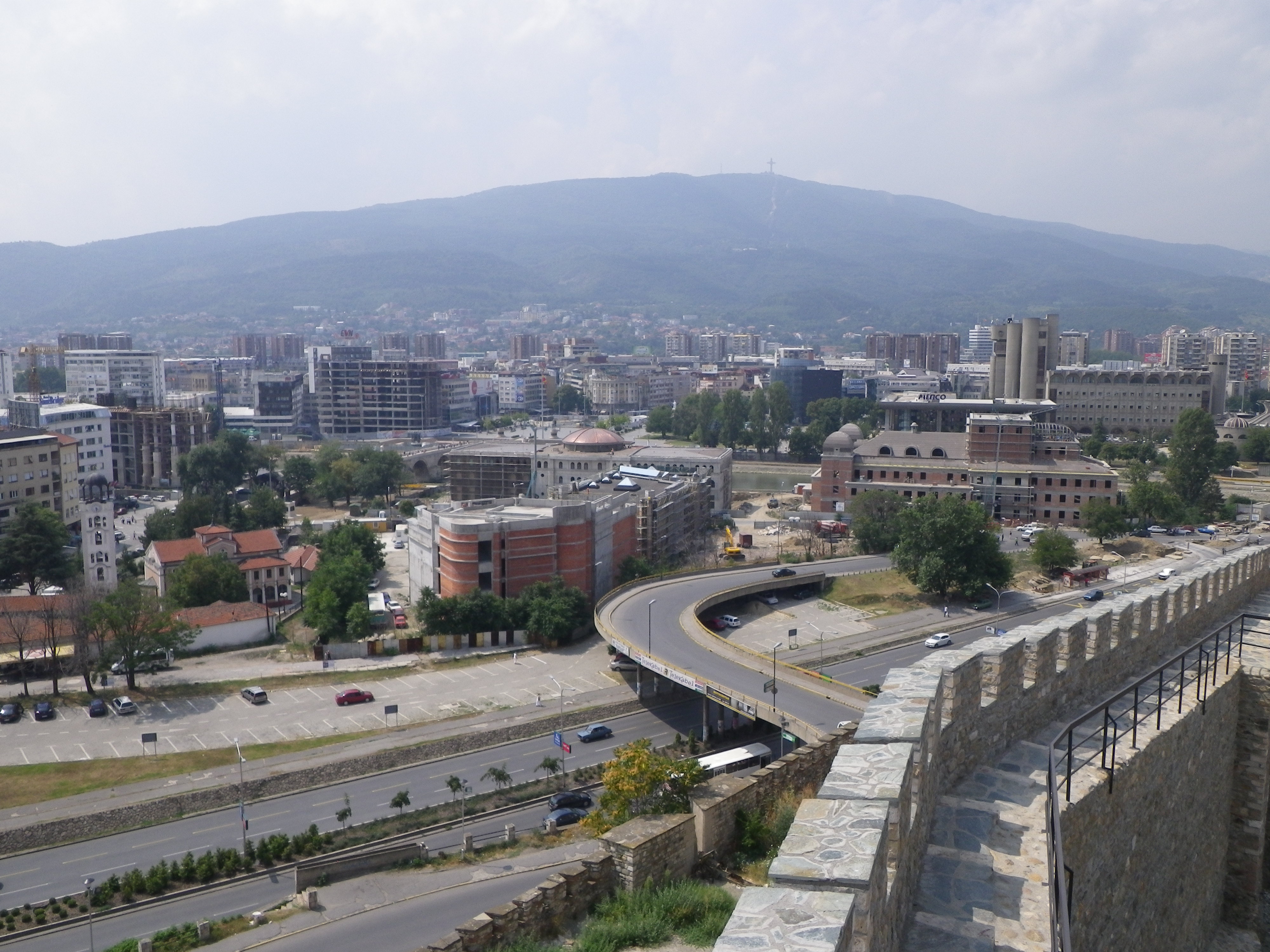
Walking around Skopje, it’s hard not to think of Chuck Palniuk’s “Rant”. It’s full of hillbillies and time travel, so what’s not to love? One bit I often think of is his painting of America as a land filled with genetic patterns. In small towns dotting the country side, a certain percentage of children are born beautiful. Those lucky few are set apart from the rest of us, and held in the highest esteem from the earliest age. They’re doted on, and more than, and before the rest of us. So much, and so soon that they’re the first to be seduced, and the first to find love. This love binds them to their small towns and weighs them down as it knocks them up. So while the rest of us run off to liberal arts colleges across the country, they’re left home raising their beautiful babies who will grow into beautiful children destined to repeat the pattern. It’s like Mike Judge’s “Idiocracy”, but everyone’s hot too.
This story stays close to mind as I wander the city center. Not everyone here is beautiful. Not a majority. But those striking few who part the crowds do so holding the hands of their young children; an army of supermodels pushing strollers. There’s such a gap between these nymph-mothers and the rest of us… it feels like the beautiful future is steamrolling over me.
Tomorrow I leave for Veles where I’ll begin my Habitat project. I will be happy for the change in scenery and the added company. Skopje has been fun and kept me busy, but there’s only so much I can do here. Today I took a taxi to a hot spring spa set into the foothills. I thought it would be an open air spa, but all the mineral waters are piped into a western-style building and diverted into a few private baths. After my soak and massage, I hiked up into the hills and across a narrow bridge spanning the river. At the top was an open fountain bubbling up with fresh mineral water. I took just a sip, but couldn’t stomach the heavy water. A mix of carbonation and copper, it left an aftertaste of blood in my mouth.

I really wanted to swim outside, but it sounded like the one outdoor pool was closed. This is the time of year when it would be most in demand, but it seems like a lot of the public attractions are closed for repair or something. My first day here I tried to get to the Zoo, but found it’s actually a Natural History Museum. Or maybe they’re connected. The implications of that suggest a low survival rate for the Zoo’s collection, but a nice growth rate for the Museum’s… dark… When I arrived, the door was open, but the lights were off. I wandered through the lobby before being shooed away by a guard. He pointed to a cyrillic sign alerting me to its closure.
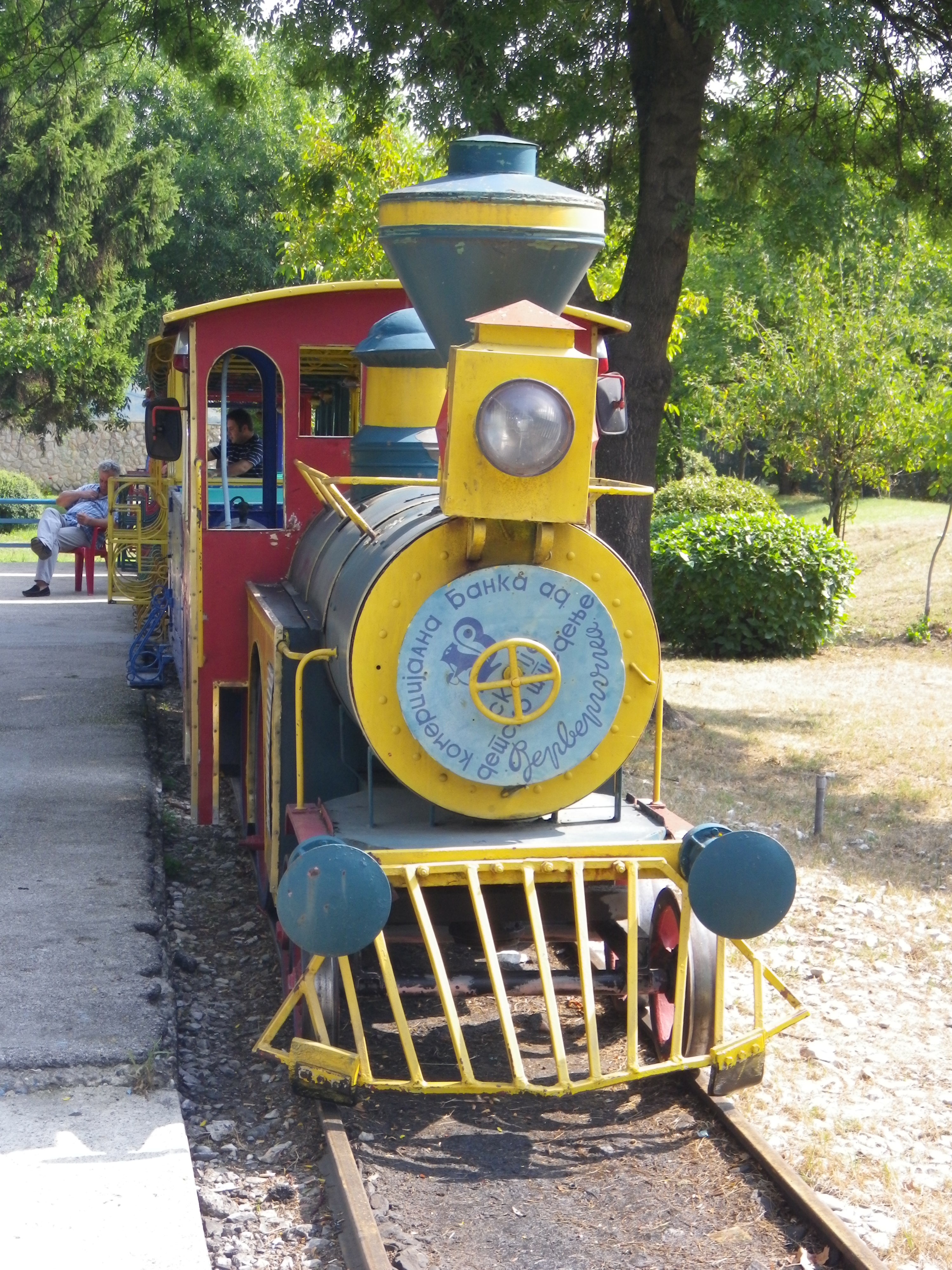
The same thing happened at a broken down amusement park where I was told I needed permission to take a photograph of the miniature train.
At the Museum of Modern Art I walked swiftly past some cleaning people sitting down to lunch and into one of the galleries. The lights were on, but I was the only patron, so I wasn’t sure if I was supposed to be there. The main exhibit was a series of a hundred photographs taken around Macedonia and India. They were snapshots mostly. I wasn’t sure what to make of them, but there seems to be a connection with India here. There’s a lot of merchandise featuring Mother Teresa.
The rear of the museum opens up into a huge space with many tiers of walkways and vast walls of windows. It reminded me of Chicago’s new Modern Wing if it had been built thirty years ago and then left to rot. The works seem local with a strong arts and crafts influence. A long flat sculpture is made up of dozens of rows of dozens of number wheels from dozens of analog alarm clocks. The ones where the wheels spin 1/10th a rotation to change each digit of time ticking by. The wheels are all similar size but with different fonts. It’s a nice effect. Another is made up of newspapers folded into long and thin strips of paper and then coiled tight into wide spirals that fit together into a hypnotic panel. It’s all very clever and approachable. I could see these sold at popup shops across manhattan.
So today I had to settle for an indoor swim at “The Olympic Pool”. It’s 200 denars to enter (about $4), but you can stay all day. I’m given a ticket that I trade for a canvas hangared bag that I put my clothes in and trade for a bracelet charmed with a number. I walk through a shallow trough of bleachy water before I enter to pool arena. I haven’t seen an olympic sized pool in a long time and it’s kind of awesome. It’s three meters deep and takes my breath away to swim one lap (though with my bum arm, that’s not saying much). It’s me and about a hundred ten year olds, but the place still feels empty. They’re completely occupied by running from the edge of the pool and leaping in at funny angles with funny faces to the delight of their friends. I float for a while, then walk upstairs and outside to lay under the sun.
I haven’t done too much here, but I’ve done it at my own pace and without a set agenda. If I stayed any longer, I’d get back to work on some of my projects. It’d be cheaper and more productive working here than in New York, but I’d miss my friends and collaborators. Since leaving Los Angeles, I’ve been shrinking my footprint and pulling up my physical roots. It’s left me very agile. It’s people who will pull me back when I return, and I think that’s the way it should be
To be on vacation, you first need to have a job. I’m pretty sure that’s how it works. If you don’t have a job (or a regular course of study), you can travel, but it’s not a vacation. So this is my first time traveling neither for business, nor on vacation. It’s something of a different feeling. In the last weeks, since I gave up my apartment, I’ve spent about ten thousand miles in the air. I’ve brought the same set of bags, with the same set of clothes on each of my little trips. So the difference here is that I’m not so much vacationing as I am relocating… however briefly. Make no mistake, I’ll be back in NY before the kids get back to school, but for now, I live in Macedonia.
I’m either getting way accustomed to long flights, or the airports in Rome and Budapest are strikingly western. I spent about eighteen hours getting to Skopje and the biggest culture shock I ran into along the way was the massive line at the JFK gate of passengers collecting their duty free cartons of Marlboros and Mentos (the fresh maker). There must be some sort of synergistic magic between the nicotine and the hydrogenated coconut oil that drives europeans crazy. Or maybe it’s the guar gum.
I didn’t sleep as much as I planned, but beyond that it was smooth sailing. Smooth air sailing. In a plane. In the air.
This is my unplanned trip. I did no research on Macedonia before my arrival. It was only after landing that I realized the country’s pronounced more like Macadamia than Maceration. Yet, thanks to the kind folks at Habitat (who maybe want to make sure I show up on time for the build), there was a dude waiting for me outside baggage claim, with my name on a sign, ready to drive me to my hotel. So much for going where the wind takes me.
At least the room is nicely sparse. I’ve got everything I need, but it’s economy helps me live out this nice eastern block fantasy I got. All the furniture is nailed down (nailed up, actually. Much of it is crammed up near the ceiling. Seriously) and cannot be moved… which plays nicely into my suspicion that the whole room is bugged!… In Macedonia, TV watches YOU! Ha Ha HA HA!
I dropped my bags off in the room and set out to get a bite to eat, and maybe a taste of the neighborhood. Skopje, the capital, is an eclectic mix. It’s something of a cross between soviet bauhaus architecture and Los Angeles suburban sprawl. Each block is dotted with residential high rises with forms following their functions straight into snoozeville. But there’s a lot of open green space, and tons of little playgrounds (you know: for kids). Right across from my hotel is a park, and just beyond that a super market. Here I can not only load up on the local currency (denars), but also do a broad survey of their consumer products.

I don’t want to sound like I’ve already gone native, but the array of products sold could give any western chain a run for it’s money. I wuss out and settle my stomach with a generic yoghurt drink, but there are endless options to chose from. I swear there were twenty different varieties of catsup. It may not be as posh as a Whole Foods, but in addition to the myriad of prepackaged goods, there are all sorts of stations in the back where food is being prepared fresh. Walking along the back aisle is like running a gauntlet of odors: deep fried bananas and fresh squeezed grapefruit juice were pretty dominant though.
After a quick shower and change of clothes, I feel good enough to go back into town for a real dinner. I make it all the way to the city center (called Macedonia Square) which seems like their Champs Elysees and Time Square rolled into one. There are all sorts of streetfront cafes and signature stores. A stone bridge separates this new part of the city from the historic core across the Vardar River.

I settle on a nameless cafe with a strong clientele. The menu is extensive and I stuff myself on a greek salad that’s so tasty it breaks my heart, and a giant piece of grilled salmon that’s size is inversely proportional to it’s price. I hate to talk about it, but the whole meal cost me just twelve dollars. The square is reasonably active with couples and families strolling around, listening to the street musicians. There’s a different look to the people: their bodies and their clothing. But I can’t say for sure I’d notice if the whole city picked up and moved to Brooklyn. There’s a certain line between hipster and eurotrash that seems to have blurred. No tattoos here though. Not sure why. Just an observation.
My walk to the square was about two miles in hot daylight. I’m trying to get a sense of the area so when I’m ready to turn in, I take a different route back to the hotel. The whole city feels very safe, but I end up on a darkened road with little traffic. I walk with purpose, but also see how frightened I can make myself. I have this thing about fear scaring off danger. It’s only when we’re not scared that things actually go south, right? I see a man walking towards me. He’s nothing but a backlit profile; a shadow. I step down into the street so we wont have to squeeze past each other if we meet at a spot where the sidewalk narrows. I turn and look back over my shoulder as a car passes me. When I face front again, the man is gone. He could have turned into a driveway, or walked into a house, but I don’t see any likely candidates. Or he could be crouched behind that dumpster waiting to jump me when I walk by. I know that fear seems silly, but imagining it is part of my little game. I walk on and every few steps, I turn and peer around any obstacles I pass. There really are a lot of them. By the time I get up to where I last saw this shadow man, I’ve looked between parked cars, and down side streets and alleys. He’s vanished. I walk straight past where he last stood, but keep looking behind me to see if he pops out again. Behind a narrow gap between two chain link fences, again backlit, there he is, standing just a few feet from me. I can’t see his eyes, but I’m sure he can see mine. I keep my pace, but turn back every few seconds to see if he follows after me. He does not.
Not yet through smacking my heart around, the city floods the street with a string of innocents passing me by; making me feel foolish for my fear. First a mother carrying her baby in her arms; out for a stroll. Then two young girls deep in a cyrillic conversation; oblivious to my presence. Finally a young boy walking a younger puppy. Skopje feels safe. But that shadow guy was creepy. No question.
We drive across rocky ground for what seems like hours. We twist and turn avoiding hulking brambles of shrubbery. We double back in the face of sudden chasms, eroded ruts dug out by previous travelers. What scars are we inflicting on this desert, I wonder. A quick tumbling in the corner of my eye is not tumbleweed, but a broken down cardboard box rushing across the ground. It’s moving insanely fast, showing just how swiftly the wind is blowing. It’s almost five miles to the outpost. By the time we reach it, the sun droops low in the sky and is darkened by the torrent of sand invading us from the south east. Pulling in to park, we pass the sandblasted shell of an old four-door from the seventies. Stripped of every last piece, it sits there on the edge of the desert, hollow and vacant like the outpost itself. In a hurry, I pack and repack, trying to minimize our baggage into the desert. I’m marginally successful but still fight against the sand to get it inside where we’ll drink tea and wait for our guide. We meet the jovial Aussies we’ll trek out with and share the sort of idle chit chat one does in such situations. Before setting out, our guide helps us tie our headscarves for protection against the sands and winds. I deeply regret not buying a flowing white one like the Aussie’s. Other than being Asian, he looks just like Lawrence of Arabia.

We set off into the storm a real caravan: Jenny in front, then me, then the Aussies. We’re strung one to the next, each camel’s nose tied to the one ahead’s rump. At the front, we’re lead by a Berber guide, walking in bare feet, his head wrapped like ours against the storm. It’s slow going, but I feel good on a camel. They’re narrow and bony at the top of their hump, but the saddle cushions me and offers an iron bar to clutch when things get bumpy. Otherwise, I just sit up straight and sway with the camel’s rhythm. We head East and then South. For a long time, the outpost looms in the distance, a reminder of what we’re leaving behind. It’s getting dark and the wind is blowing fiercely. I worry we’ll come to camp any minute, still within eyeshot of civilization: children playing in the desert, still in the shadow of the city. But we trek on and on, and when it’s been a mile since I’ve seen a sign of man, I relax.

It makes me sad that I cannot talk about the desert without talking about dung. The whole way out to camp, Jenny’s camel left little presents for the shiny black beetles along the way. But theirs was an eternal Christmas, those beetles, along this path through the sand. For six years, every day, tourists trekked across this land atop these prolific beasts. For six years, every day, the winds blew the round pellets into every low valley, dusting the desert floor until it was painted a deep gray. Our guide trudges barefoot through it, kicking up black sand as he pulls us along. Throughout our time in the desert, it will be a constant struggle to avoid the dung as we make our way from place to place. I hate feeling squeamish about this raw land we’re invading, but I know this is not the natural way. It’s only our bizarre presence here where we do not belong that’s created this abundance. Without these breadcrumbs left by all the Hansel and Gretel’s who trekked out before us, I might have spent my time in the desert as one does discovering a new and secret place. But every dark patch I see speaks of dozens of travelers come before us. I don’t want the fantasy, but someday I do want a little untouched beauty. Mars, here I come.

After about two hours, the archipelago of dark spots on the horizon grows into a crescent of tents facing each other at the foot of a large dune. They’re a patchwork symphony of rugs and rope and posts. The large center tent is open and as we stumble off our kneeling camels, we’re guided inside for tea. We chat in growing cold and darkness until our guide comes and lights a burner that hangs from the center post. The hot white flame consumes a hiss of gas and is too bright to look at. When the food arrives, I dig in with a fervor and eat an obscene amount of vegetable tagine. Desert life makes me hungry, apparently. We walk out into the cool desert air, full and sleepy. The wind has died down and swept away the clouds leaving a bright and starry sky. A halo around the moon stretches on forever filling most of my vision. We tiptoe through a field of dung to a lie on a low dune and gaze up at the night sky. In Austin I saw an IMAX that dove deep into the space behind Orion’s Belt and lying there in the sand, surrounded by the infinite both near and far, I revel in the size of it all.

Sleep comes quickly, there inside our carpeted tent. But it’s interrupted by frequent howling gusts that bat the walls and drive sand through the roof onto our bed. The wind finds every seam, offended by the tent’s interruption of its long journey across the sand. We wake, covered in a fine layer of deep red dust.
After a tasty breakfast of omelets and jam, we take our guide’s suggestion and hike up to the tallest nearby dune. It’s less than a mile, and looks even closer, but it’s a steep climb through loose sand and we stop often for breaks. Every foot we climb, and every inch the sun rises, gives us a new landscape of rendered dunes to look out across. It’s hard going, but feels natural and we make good time. At the top, I pull ahead and rise over the crest full of anticipation for the view beyond. The sands do spread out into infinity. The sky does loom over the raw landscape. The breath is taken from me. But before all that I see the three beer cans and empty bottle of wine the last trekkers left. Lovely. But it’s a nice French bottle and the sun and sand have stripped the cans of their decals. If there were a bleached skeleton desperately clutching one of the cans, it would have been perfect.
At Jenny’s prompting, I rush back to her lower camp by tumbling down the steep and sandy dune. Round and round I go. It’s over in a flash and I sit up with sand everywhere. Everywhere. The barrier my clothes once served keeping me on the inside and the sand on the outside is now just a rough suggestion. I will be picking copper sand out of my ears for days. Back up we go to the dune top. We’re just on the edge of the Sahara. It extends South across half of Africa. But from where we sit, surrounded by sand, the Sahara is our entire world.

The descent takes about ten minutes, but after lunch we’re still in the desert so we set out again on another hike. Heading in a new directly, we climb a low dune and relax in the afternoon sun. There’s nothing to do but lie around and contemplate the sand. Beneath us, hidden from our camp by a dune is a darkened spot of sand, sprouting with green. To one side is a stone well. The closer we get, the clearer it is that the small valley is drenched with water. The sand is wet and glistening. I don’t understand enough about the desert to know why this water can live so close to so much drought.

We pack our bags and lash them to our camels. We’ll trek out farther into the sand for a higher peek at the sunset before heading back to a new camp for the night. Already the sun is getting low, but our guide laughs off my concerns at the approaching darkness. The deeper we go in, the farther we must ride out. And while the moon lights a bright path, we traverse some narrow ridges along the way. I don’t mind the idea of falling in the sand. It’s the camel coming after me that arouses concern. We arrive at the foot of a dune in no visible way different than dozens we passed. But this is the one we’re meant to climb. This is the one from which we’ll watch our first desert sunset. It’s rough going, but we’re fighting against the rotation of the earth so we try to keep a good pace. Google maps tells me we peaked at about 500 ft. Imagine if you will, climbing a twenty-five story building. Taking each step. Now imagine that staircase flooded with sand. That’s what we did. I wish I could rave about the colors of the African sunset. I wish I had pictures to make you cry. But there are no clouds over the Sahara. The sun low in the sky, kissing the tops of the dunes goodnight, leaves the sky not in a fiery explosion, but a pale and gradual darkening to night. And now it’s dark. And we’re on a dune. And our camels are dots in the distance far below. It took a long time to climb up, and neither of us wants to take the same route back down. But the alternative is steep, steep, steep. It’s scary. Jenny is scared. I don’t want to embarrass her, but I don’t realize how scared until her peals are more tears than laughter. I joke, and I minimize, and I pull. There is a danger of falling. But the sand is soft and it seems more dangerous to stop moving. It’s a relief to get back on the camels and let them worry about the footing for a change.

This is the farthest we get into the desert. About five miles deep. From here on, it’s back to civilization, with a brief stop in the bronze age at a nomad camp. I’m still not clear on how that one differs from the tent camp we just occupied, but I have the hour long camel ride to wonder about it. Bumping along on Zero (my camel), I locate my ipod and enjoy a little Yusuf Islam over the quiet of the desert. Wild World, indeed. ‘Torn shattered and tossed and worn’, we stumble into camp. It’s always an appropriate arrival when the camels lurch forward into their kneel to let us off. I can think of no better rickety display of disembarkation than the way these massive beasts lower themselves. To match it, I’d have to walk in the door from a long journey, drop my bags, drop to my knees, and then drop face first into a vat of mashed potatoes.
Our tent for the night is more of a carpeted hut; a pillbox bunker upholstered in rugs and burlap food sacks. But whereas our last tent was just a series of overlapping layers, this one is built. The wind buffets the walls, but no sand squeezes through. We recline on thin mattresses by candlelight and wait for dinner. Mohammed (our guide’s young son) joins us for a while and sucks us into his car games. Jenny plays smashup for a while, but he seems more amused when I ignore the car’s form and treat it as a talking action figure. We here his parroting my english babble well into the night.

Dinner is another explosion of vegetable tagine. The food all blends together just a bit less that the deep dark sleep that soon follows.
We conked out especially early that last night on the sand to fit in a desert sunrise before heading back to the outpost. This time just before sunrise is the desert’s coldest and the only time I’m glad I brought my coat. But the sand is a simple landscape, and the sunrise in no way outshines the sunset the night before. The dunes have just two sides at any time; the one lit and the other dark.

We grab a light breakfast that hopefully will not disagree with our bumpy camel ride back into the world. The trek is over the moment the outpost peeks over the horizon. It’s a relief to be back, but this desert was the reason I came, and all I’ll have now are memories.
We set out with the highest of hopes and rock solid plan to figure things out when we got there. Our rooms were booked, and our agenda set, but the details on how we’d get from one place to the next were less clear. There are taxis and grand taxis and drivers and buses. There are camels. We would make it.
The flight takes seven hours. If we sleep, we land in the Moroccan morning refreshed and ready to take in Marrakech. We do not sleep. We watch some Lost, do some crosswords, and generally squander our time to rest. I began The Sheltering Sky and girded myself against visions of post-war Morocco and the dangers of entanglements foreign and domestic. Our layover in Casablanca was one blink of an eye, and then another for the flight to Marrakech. We found our driver and headed out of the city to Kasbah Dar Ilham. On the way there, I believe I’m in Africa when I see a few cows riding atop the roof of a truck, penned in by the shortest of walls. We arrive at the Kasbah and it truly is an oasis from our long travels. Set in a palm grove, it is the standard for the places we’ll stay. We’re served steaming mint tea, a mixed BBQ, and vegetable tagine. While the food in Morocco is less diverse than in India, it’s well spiced and suits the environment in a way that nothing else could.


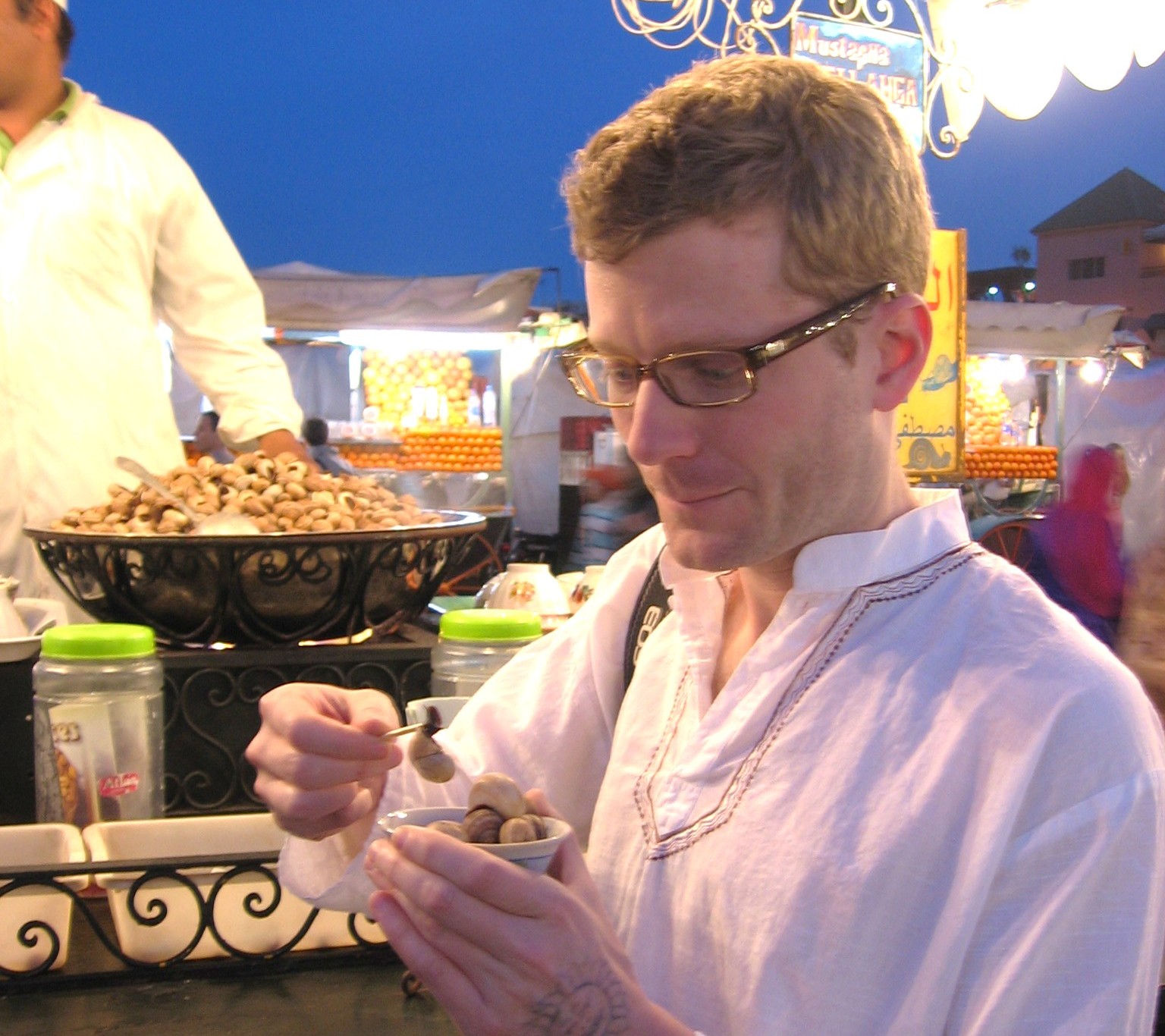
We grab a few hours of sleep before heading back to the city to see the Marrakech nightlife. The central square of the Medina is bustling with tourists and street vendors. We grab a bowl of snails from a stand for 5 dirhams (about $0.65). This is the cheapest food we ate and some of the tastiest. These are not French snails drowned in garlic butter, but Moroccan, boiled in spiced water, still clinging to their shells. Just off the Medina winds street after street of souks: small shops selling touristy goods to the streaming parade of visitors. I think I’ve finally overdosed on souvenirs and enjoy just watching all the madness. I’m enthralled watching a man lathe some shish kebab skewer handles with his feet. He uses his hands to spin the dowel along its axle using a little bow. It’s as if he’s trying to start a fire on a desert island. With his foot he pushes the chisel into the dowel, notching out intricate details into the wood.

We head back to the kasbah to catch up on the lost sleep and spend a night in the quiet of Africa.
Our first full day in Marrakech, we devour as many tourist sites as we can. The Mederrsa Ben Youssef is an old school, built in the 1500s for theological studies. It’s a maze of small rooms, spiraling off into even smaller rooms. A few are done up historically to show how scholars sat and read from religious texts. I imagine they did a fair amount of duplicating as well. Next it’s on the Museum of Marrakech, where we spend about fifteen minutes. It’s a beautiful building, with a main room dominated by a mammoth lantern, but otherwise there’s not much to see. We cross the street to the Almoravid Koubba. It dates back to the 1100s and has some really creepy rooms under the ablution chamber. Wikipedia tells me that the inscription over the entrance reads:


“I was created for science and prayer, by the prince of the believers, descendant of the prophet, Abdallah, most glorious of all Caliphs. Pray for him when you enter the door, so that you may fulfill your highest hopes.”
We have another lovely dinner of meat for Jenny and vegetable tagine for me. Everywhere we go, the city is infused with dark warmth that speaks of hospitality given to countless travels over centuries. Marrakech is for tourists, but I feel like it always has been. One of the last stops between the ocean ports and the long long trade routes deep into Africa. We did not come for Marrakech, but we enjoyed our time there. We head back to the kasbah excited to leave in the morning for the desert.
To get into the Saharan Desert, we have to cross the Atlas Mountains. They get as high as 14,000 feet, but per my habit we take the low road and cross at a mere 7,400. The road ahead of us is breathtaking, and unlike any other climate I’ve seen. I really feel like I’ve gone somewhere. We climb through the morning mist. The road snakes through the peaks, and brings us by small nomad encampments. Many have setup makeshift roadside stands where they sell local minerals and geodes, and even fossils pulled from the Atlases. I contemplate buying some trilobites, but get a little creeped out when I see all the legs. It is not an easy drive, and we leave the windows open to get some air as the hair pin turns taken at breakneck speeds threaten our constitution. We pass a herd of black goats mingled within a heard of white sheep. Their mountain-side checkerboard of fluffiness is almost overwhelming.

By the time we’re through the mountains, we’re just a short drive from our stop at the UNESCO World Heritage Site Ait Benhaddou. We park the car on the side of the road and hike down some switchbacks trying to end up at the foot of the compound. But lying across our path is a river about 30 feet across and a couple feed deep. It’s free to roll up your pants and walk across, but the donkey rides cost a few dirhams each. For some reason Jenny is not allowed to ride alone, but otherwise we make it across without incident. Ait Benhaddou is a collection of individual Kasbahs that make up a decent sized fort. It’s similar in scope to one of the Rajasthani forts I saw in India, but instead of being a singular structure devoted to protecting a seat of power, it’s a community of families tied together for mutual protection. Like most historical buildings in Morocco it’s built from a mixture of dirt and clay and straw and rocks and wood. Every time it rains, the exterior changes. It must be under constant repair, but retains an authentic and timeless look. Movies of every era have been shot here, from Lawrence of Arabia to the 1990 adaptation of The Sheltering Sky. Even Time Bandits shot here. There’s such a beauty and authenticity to this place, and it’s set in such a remote location, that it makes some of the other sites I’ve visited over the last year seem like tourist facades.

 For another few hours we drive down long roads stretching out across rocky African plains. We stop here and there for photos, but make haste to get to Kasbah Itran before nightfall. None of these places have clear addresses, and some have the same names as other establishments, but we find it just as the sun is setting the countryside into darkness. This place is weird. While it’s been renovated for modern use like most of the Kasbah hotels, it retains much of its archaic charm. The whole building is heated by a central fireplace, and once the fire begins to die a chill sweeps through. Electricity is strung haphazardly throughout with outlets hiding behind tapestries, and random wires dangling out of alcoves. Our dinner of meat and vegetable tagine is followed by a lively drum session from the Berber staff. It’s casual and festive and gets everyone in a good mood. Afterward, a young man in a robe and turban gathers the guests around a small table where he demonstrates a series of riddles and magic tricks using a few props like candles, coins, and glasses. It’s entertaining and we sit transfixed on his movements pretty late into the night. We stumble up to our room and pile the sheets and blankets from two beds on top of ourselves to warm us through the night.
We set out early for our last day of driving before we reach the desert. The landscape continues to amaze. The rocky vistas are flooded with bright green eruptions of grass and trees. It must be our proximity to the coast, but even as we approach the sands there is a well kept balance between drought and deluge. Films lead me to believe the oasis were rare jewels dotting the country, but maybe they only seem that way when one is on camel or on foot. We stop at the Todra Gorge, a narrow rift between rock cliffs where a thin stream pushes water fresh from a spring across the cracked earth. It’s a tourist haven with restaurants dotting the path, and rock climbing operators helping the ambitious scale the sheer walls. We wanted down the stream, snapping photos of the various amazements. Before long we’re back in the car and back on our way.

 Amidst a barren stretch of land, white with salt, we pull to the side of the road at the site of a nomad well. There’s a makeshift winch built to add leverage for the water’s hoisting. Jenny poses for pictures as a nomad walks towards us from a ways off. I flash back to the amazing scene in Lawrence of Arabia where Omar Sharif snipes Peter O’Toole’s guide for drinking from his well. I try to explain to her the power of the line, “My name is for my friends, and my friends are not murderers!”, but I can’t pull it off. We hustle back into the car before the nomad reaches us and pull away as he holds up some small crafts he wanted to sell us.
Our last stop before the desert is a factory where the rocks and fossils mined from the mountainside are cut and polished into the tourist treasures sold at every turn. It’s an impressive operation with saws and grinders and polishers. I stand too close to the massive saw slicing a giant block into thin slabs and get covered in a layer of paste made from the pulverized stone and the water used to cool the saw. They make everything from tiny key chains, dotted with fossilized organisms to polished countertops teeming with trilobites and spiraled gastropods.
Back in the car, we race through currents of sand blowing across the countryside. It flows in ripples and waves, blanketing everything in a fine layer of grit. With our windows open, that includes us; especially our ears. It’s a few hours before sunset and a sand storm is coming. Roadside signs point the way to Merzouga where we will transfer at an outpost from our piloted car to our guided camels. But rather than follow the signs, at a seemingly random point in the road, we veer off into the rocky plains. Here, the desert is littered with shrubs. We’re off-road in the Sahara in a growing sandstorm that’s blotting out everything beyond a few dozen feet. We’re on our way to the desert.

More to come…
This third time at Joe’s Pub was for a music and reading series called Happy Ending. The title comments a bit more on the narrative nature of the performances than the naughtiness of the event’s embrace. MC Amanda Stern follows in the same glorious footsteps as hosts of other cabaret lineups like The Moth, and How I Learned in her rabid self deprecation and referential comedy. Unprepared with a theme for the evening’s performance, she polled the audience for suggestions, calling on folks by randomly picking initials and berating their flawed ideas. “Rococo” and “Handsome Men” were rejected out of hand, but “The Alphabet” was deemed acceptable, and then left unmentioned for the rest of the night. It’s fine by me, as authors attempts to conform to these rando themes are usually a stretch detracting from their work.
The first performer is Holly Miranda, a pretty-pretty girl, grunged up nicely with a deep blue slightly sparkly guitar for a bit of flair. An ethereal lilt to her voice, she’s well beyond my busted capacity to appreciate music, so I can only assume she’s a genius. Her narrative interstitials charm me. She tells the tale of her teasing a dutch reporter, He reviews her album and asks, “Are all your songs about your highschool boyfriend?”
“I dropped out” she says.
“I’m gay” she says.
“I’m charmed” I think.
The first reading is by Josh Ferris from his second novel, The Unnamed. He’s a young guy with buddy holly glasses dressed in coffee house splendor. The story’s alright. It’s got a terse rhythm to it reminding me of James Elroy in a kind of bad way. I’m fairly certain the whole passage he read was written to justify his turning of the phrase, “futility made off with his heart.” It’s basically worth it. The story centers around a dude with some brain condition, giving it a Joe vs. The Volcano vibe. That endears it to me, as does the weird segue into the protagonist bonding with his daughter over season after season of Buffy the Vampire Slayer.
I’m not used to such structured readings. Most of the events I attend are true life stories read without notes. I find their honesty and energy entertaining. I’m unprepared for how much power and drama is conveyed by a well prepared story, read aloud. The next reader, Ron Carlson, directs the writing program at UCI nearby where I lived for a year and six months and dated much of the student body. He’s a professional. Aged and experienced. His story is an intimate confession told by the inventor of a time machine, justifying his decision in destroying it and erasing the plan. It sounds trite, but deals with the arising issues in a practical and specific way. The time machine is destroyed not because of it’s broad effect on the world and its history, but because of the futility of attempted changes no matter how mundane. I hear it as a parable urging us to change our now, and move past our then. I hear it as encouragement that when you work on something for a decade or two, you get good at it. Real good. I’ll go buy his books.
Up last is Padget Powell, a disheveled specimen on the progression of the night’s writers from young turk, past wizened professor, climaxing with mad recluse. A darwinian illustration of the decent of creative man. For reasons beyond me he begins by demonstrating how he cuts his own hair. Seriously. He reads from his work “The Interrogative Mood: A novel?” It’s a series of amusing questions, parts koan, parts narrative delving into our perceptions on the past and how it effects our modern world. It’s a litany of questions flowing in one huge bulge across a country of ideas. There’s a rhythm to it, but it doesn’t quite build into a cohesive whole. It leaves me wondering how different the experience is from reading Dianetics (I understand that’s questions too?). On it’s own, it would have been an odd reading, but in the context of the other stories, classic in their structure and formal in their story, it’s a refreshing departure.
I stumble out into the cold slushy night. With a little help from the subway, I slide over to cousin B’s for family bonding. New York for me is the city of many stops. In LA there are one or two per day, but here, with the trains and cabs and bars there’s always one more out there in the late late night. It’s addictive and makes the city indispensable to its people. There is no way to move on. There is no substitute.
 Zachster